
Tracing Former Shawano Owners
A Shawano County title chain runs through recorded deeds, newest first. You start with the current grantee. Then hunt that person's grantor in the next earlier deed. Treat it as a sequence of instruments rather than a ready-made list. At every link, check the legal description. Check the parcel reference, recording date, and party names against each other. A near-match with a different land description is a warning sign. It usually means you have drifted onto someone else's property. Keep a working table as you go. Pull every name and date straight from the actual Shawano instruments, never from a sample or a guess.
| Transfer point | Grantor to grantee | Instrument and date | Land match |
|---|---|---|---|
| Most recent transfer | Copy both parties from the latest deed | Record the instrument type and filing date | Compare parcel and legal description |
| One step back | Search the prior grantor as grantee | Record the earlier deed reference | Confirm the same tract or lot |
| Earlier link | Repeat with the new grantor | Note any estate or correction filing | Check the description again |
Deed dates and recording dates are two different things. The signature page may carry an earlier date than the filing. Note the instrument type too. An executor's deed, survivorship instrument, quitclaim, sheriff's deed, or correction can explain why the buyer-to-seller path suddenly changes form.
Reading Shawano's Grantor Index
RecordEASE's grantor/grantee index reaches back to January 1, 1986, and its tract information starts March 16, 1995. It is a working online copy, so omissions and later modifications are possible. Search the current deed's grantee first. Read the prior grantor, then search that grantor as a grantee to find the earlier purchase. Confirm each result in the recorded image rather than trusting the results list. Name spelling matters enormously. Initials, entity endings, and party role can all hide a match. A trust or an LLC may show up as grantee, so search the exact name and check the representative capacity. When an estate or survivorship filing breaks the simple chain, probate records and later instruments explain the transfer better than forcing it into a sale pattern. Volume-and-page searching stopped after August 2, 2001. The public login instruction tells users to enter 1860 for plat maps. Those quirks are search tips, not proof that every historical deed is online. The Shawano RecordEASE public notice displays the index start dates and the legacy search instructions.
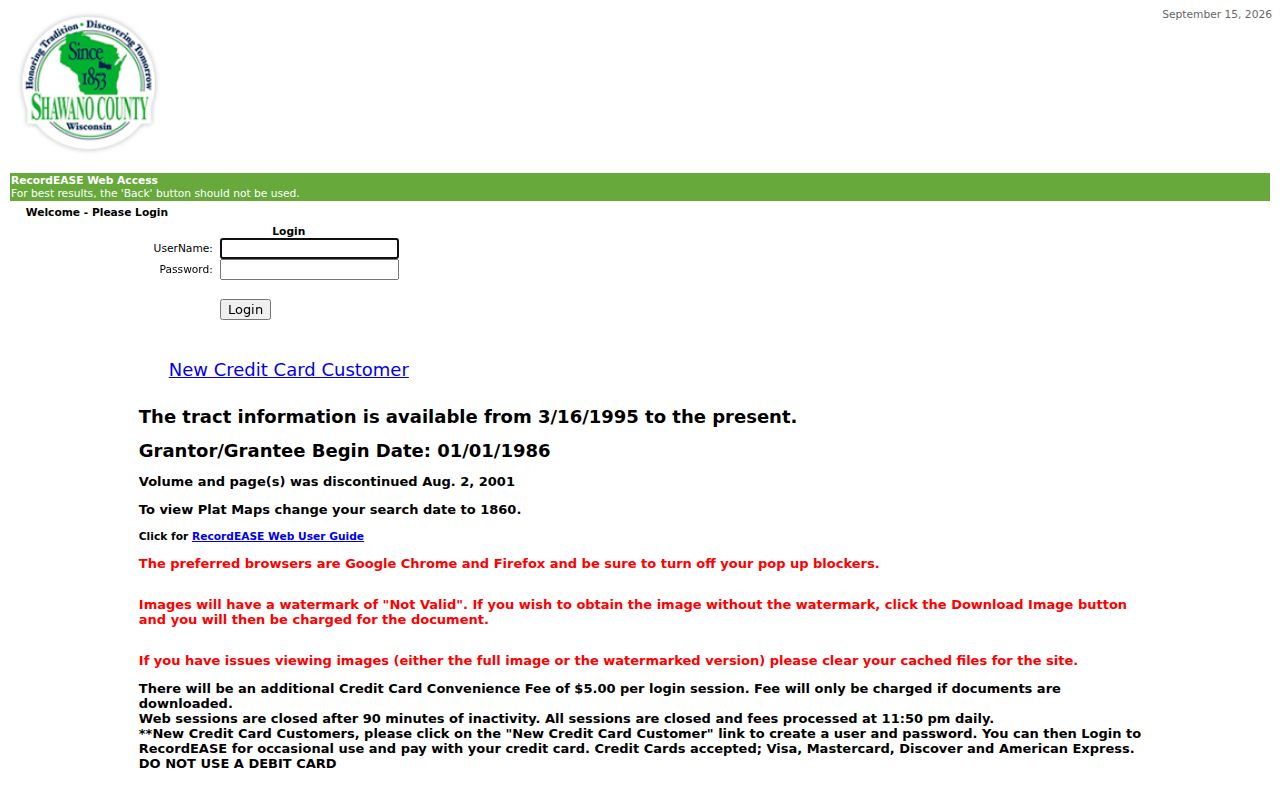
The RecordEASE login screen displays the separate online start dates for party and tract information before any search session begins.
Walking Back a Shawano Title Chain
Use one consistent backward method for former Shawano County owners. The point is to identify each recorded conveyance touching the same land. It is not to collect names that merely look related. Start with the current tax roll owner from Ascent. Then locate the deed into that party. Let the prior grantor carry you another step back.
- Capture the parcel number and legal description from Ascent.
- Search the current owner's name as grantee in RecordEASE.
- Read the grantor and recording reference from the matching instrument.
- Search that grantor as grantee and repeat, checking the land at each link.
- Stop at the online cutoff and ask the Register of Deeds about older volumes or microfilm.
- Grantor
- The party transferring an interest in the document.
- Grantee
- The party receiving the interest.
- Chain of title
- The connected set of recorded instruments affecting ownership over time.
- Reverse search
- Moving from the latest grantee to the prior grantor, then repeating.
- Quitclaim
- A deed that conveys the signer's interest without the same warranties as a full title guarantee.
Parcels sometimes change legal description after a split or plat. When that happens, compare the older instruments against the current survey and map. A chain may pass through a larger parent parcel before the lots were divided. Record each instrument reference along with its land description. That way the piece you are tracing stays anchored to the earlier tract.
How Far Shawano Owners Reach Back
The online grantor/grantee cutoff is 1986. Tract information begins in 1995. For deeds older than the party-index range, ask the Shawano Register of Deeds about bound books. Ask also about grantor and grantee volumes, microfilm, and staff-assisted access. No complete year-by-year inventory of the older deed books appears in the public sources. Name your parcel and date range, and confirm holdings before traveling. For older land context, the Wisconsin Historical Society has digitized a Shawano County plat book. It was created circa 1917 to 1923. It holds an index, community maps, and PLSS township and range sheets across 27 unnumbered leaves at roughly 1:50,688 scale. The atlas helps interpret an earlier property's name and shape. It is not a deed index, however. Compare it with the recorded description and the current GIS map. The Historical Society catalog identifies the digitized atlas. The Shawano County Historical Society's Sikora Archives accepts local research requests. It does not publish exact directory and obituary runs, though.
Probate Links in Former Ownership
Probate explains who could lawfully sign for a deceased owner's land. Shawano County probate files from 1994 forward sit online through WCCA, open to anyone. Older files remain with the local Register in Probate for 75 years before passing to the Wisconsin Historical Society. UW-Green Bay's Cofrin Library serves as the long-term repository. A will filed within 30 days of death grants no authority. It does not let anyone sign for an estate. Domiciliary letters establish that authority.
Look for a petition, inventory, claim, order and transfer instrument. Real estate can move through an executor deed. It can also move by court order, affidavit, survivorship instrument or deed from heirs. A death certificate proves the death event only. It is not proof of title. Confirm the parcel against the instrument recorded with the Register of Deeds.
Very old probate files may have left the courthouse. Give the office a case name or number. Ask whether the file is local or transferred. The online case index answers one question. The recorded land instrument answers another.
Historic Sources for Shawano Land
The Wisconsin Historical Society catalog offers Shawano-filtered pre-1907 birth, marriage and death indexes alongside local images and newspaper or obituary items. These sources can tie a name in a deed to a family or historic place. They never replace the deed chain. The Shawano County Historical Society's Sikora Archives & Reception Center accepts research requests. Hours are Mondays, 10 a.m. to 2 p.m., except holidays.
No official page publishes an exact year-by-year list of city-directory, reverse-directory or obituary-index holdings. Ask the local archives or library for the title, years, call number and any search fee, and whether staff will search by address before you plan a visit. A 1920-era plat atlas helps too. It may show an earlier community name or road reference for locating a chain link. The Historical Society archive page lists hours and request information.
This local contact aids historic Shawano County deed research by adding context for names found in old property records.
State Vital Indexes and Shawano Names
Wisconsin's vital-record indexes can support older ownership work. Access works differently than a deed search, though. The State Vital Records Office publishes no indexes online. In-person genealogy access requires an advance appointment, Monday through Friday from 2 to 4 p.m. Distinct cutoff periods govern birth, death, marriage and divorce records. Recent certified copies carry relationship or direct-and-tangible-interest restrictions under Wisconsin law.
Shawano County's Register of Deeds holds birth certificates from October 1, 1907. Death certificates there date from September 1, 2013. Marriage records are all available through that office. Divorce certificates date from January 1, 2016 forward. Older divorce matters go through the Clerk of Courts. Vital access is separate from finding an owner of record in land records. Request only the record your property question needs. The Wisconsin genealogy access page gives the in-person index ranges and appointment protocol.
State rules shape what a name search can reach beyond land records. Vital indexes answer identity questions, not title ones.
When a Shawano Chain Breaks
A clean chain can stop at an estate. It can stop at a correction, a survivorship transfer, a plat vacation, or an index gap. A missing RecordEASE result proves nothing. The owner may still have held an interest. Try name variants, inspect the document type and search the legal description. Ask the Register of Deeds about historical books as well. When probate appears, connect the court's authority to the recorded instrument affecting the parcel.
Shawano County's digital depth is known through RecordEASE. No exact older book run is documented. No courthouse fire or imaging gap is on record. Never invent a reason for a missing link. Record the last verified instrument. Note the years searched and the source. Then ask the custodian about offline series that could continue the chain.
Former Shawano Owners and Proof
Rebuild former owners only as far as records support. Later corrections, unrecorded interests, estate authority and parcel changes all still matter. The online index has a stated starting point. Older materials need a separate request. A deed list is not a title opinion. Keep names, roles, recording dates and land descriptions together so another researcher can retrace the path. For one instrument copy, use the Register of Deeds and cite its recording reference. To trace the present owner of record on the tax roll, start with the current Shawano County owner record explanation.
Online time depth. Shawano County's grantor/grantee index begins in 1986; ask the Register of Deeds about older books and microfilm rather than assuming the web index is complete.
Note: RecordEASE images display "Not Valid" until downloaded, and the public fee notice should be checked before opening a copy.