
Shawano County Deeds and Transfers
The Register of Deeds keeps Shawano County deed records. RecordEASE provides the public web index with images. A deed is simply an instrument recording a transfer or change in a land interest. Its real legal effect depends on the text, the signers and the surrounding records. The label on a search result tells only part of the story. Mortgages, land contracts, liens, plats and releases live in the same land-record system. Read the instrument type carefully before you conclude anything about ownership.
| Instrument group | What it records | Common Shawano use |
|---|---|---|
| Transfer deed | Grantor, grantee, date and legal description | Follow a purchase or other conveyance. |
| Quitclaim deed | Transfer of the interest the signer holds | Trace a family, estate or correction transfer. |
| Executor or administrator deed | Transfer made under estate authority | Connect probate administration to a parcel. |
| Sheriff or tax deed | Transfer after a court or tax process | Confirm against WCCA or Treasurer notices. |
| Mortgage, release or land contract | Recorded financing or claim, then possible discharge | Check encumbrances alongside a deed. |
A deed is not a mortgage. A tax-bill owner line is not a deed either. Shawano County's official repository holds deeds, land contracts, mortgages, liens, plats and releases together, and a later release can change the status of an earlier claim. Inspect linked instruments in date order rather than stopping at the first result.
RecordEASE's Grantor and Grantee Index
RecordEASE splits its online coverage into two ranges. The public notice says grantor and grantee indexing starts January 1, 1986. Tract information begins March 16, 1995. Volume-and-page searching ended August 2, 2001. The public page shows a username and password entry. It also offers a registration path for new credit-card customers. Beyond those public date, grantor/grantee and tract references, the portal does not publish its full document-type list on the open screen. Nor does it show its search-form labels there.
Start from a known parcel on Ascent or the current roll owner. Then use the party index to find the transfer. The grantor transfers the interest; the grantee receives it. The chain of title is the sequence of recorded transfers for one parcel. Older filings carry a book and page reference, while modern ones use an instrument number. Because RecordEASE retired volume/page searching, follow its current interface and request older bound material through the Register of Deeds.
| Publicly confirmed entry | Coverage or format | What to capture |
|---|---|---|
| Grantor/grantee | Begins 01/01/1986 | Name, party role, date and instrument reference. |
| Tract information | Begins 03/16/1995 | Parcel or land reference and document details. |
| Search date | Plat maps: set date to 1860 | Use only for the plat-map route described by the site. |
| Volume/page | Search discontinued 08/02/2001 | Ask about book or microfilm access for older entries. |
Note: The 1860 date instruction is a portal-specific way to reach plat maps, not a claim about deed coverage.
Walking a Shawano Deed Chain
A Shawano chain search works backward. It moves one grantee at a time. Treat the Ascent name as a starting point only. Match every instrument by legal description, parcel reference, recording date and party names. An estate or entity party can make the next step less obvious. Track each grantor and grantee. Note the instrument number as you go. That habit keeps a similarly named person from pulling the search onto a different property.
- Use Ascent to capture the parcel number, owner name and legal description.
- Search that owner as grantee in RecordEASE and locate the deed into the current roll owner.
- Read the prior grantor on the instrument, then search that name as grantee.
- Repeat backward, matching land description and dates at every transfer.
- When the search reaches the 1986 online party-index start, ask the Register of Deeds about older books or microfilm.
- Grantor
- The party shown as giving or conveying the interest.
- Grantee
- The party receiving the interest in the instrument.
- Chain of title
- The ordered series of deeds and related instruments affecting the parcel.
- Party index
- A name-based entry path; it may require spelling and entity variants.
- Working copy
- RecordEASE's online index and image, which may be corrected or incomplete.
Trusts, LLCs, personal representatives and estates all show up as named parties. Search the exact entity spelling and read the signatures or representative capacity on the instrument. A survivorship transfer, correction deed, quitclaim or unrecorded interest can break a simple buyer-to-seller sequence.
Opening a Shawano Deed Image
The RecordEASE login screen posts the image charge before any search begins. Images carry a "Not Valid" watermark until downloaded. The cost is $2 for the first page under Wis. Stat. §59.43(2). Each additional page is $1. A $5 credit-card convenience fee applies to any session that downloads documents. The card number is entered per session and never stored. Sessions close after 90 idle minutes, and fees process at 11:50 p.m.
Read the whole image in context. Confirm who signed and who received the interest. Check the legal description too. Review the acknowledgment and recording marks. The index helps you find a document; the custodian can explain certified copies. In a title matter, a screenshot or watermarked image is no substitute for a certified instrument.
The Shawano RecordEASE entry screen displays its date coverage and download terms. The Register of Deeds sits in the Shawano County courthouse at 311 N Main Street. The office answers at 715-524-2129.
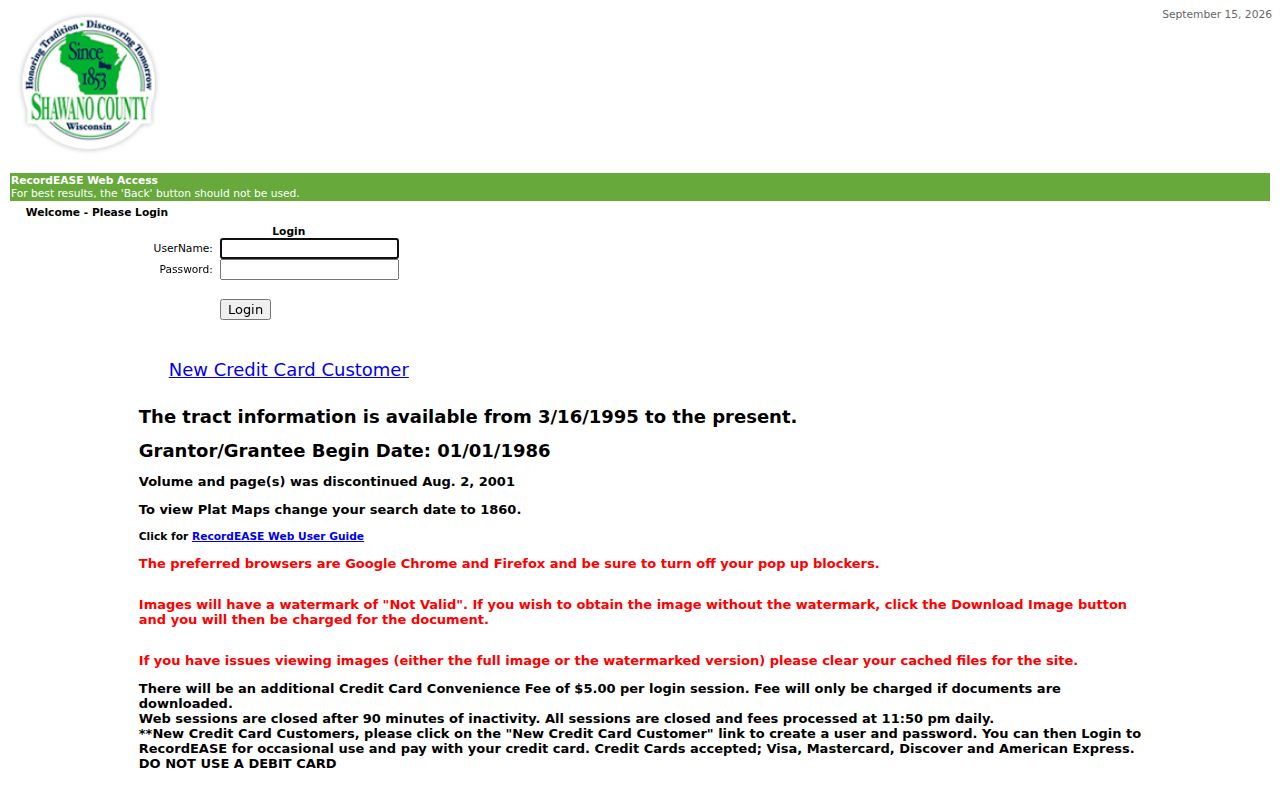
The posted notice draws a clean line between finding an index entry, which is free, and downloading a document image, which carries a fee.
Recorded does not mean guaranteed. An index result is not a title opinion, and an unrecorded interest may not appear. Confirm a legal conclusion through the custodian or a title professional.
Older Shawano Deed Books
The public RecordEASE notice offers no book-by-book run before 1986. For earlier transfers, contact the Register of Deeds. Ask about bound deed books, grantor and grantee volumes, microfilm or staff-assisted search for the parcel and dates you need. Give the office the name spelling, the township-range or legal description, and a likely date span. A historical volume may use a different locator than the online index.
The Wisconsin Historical Society's Shawano County atlas dates from roughly 1917 to 1923. Its town, village and township leaves, index and PLSS references can help decode an old land description. Still, the atlas is not a deed book. Compare its geography with current GIS. Rely on the recorded instrument to establish the transfer.
The digitized Shawano County plat book catalog lists 27 unnumbered leaves at a scale near 1:50,688. It shines when an early deed cites a road or place name. That name may no longer appear in an address search.
Property Watch After a Recording
Shawano County Property Watch sends an alert when a registered name or tax ID receives a new recording. The form asks for a name or parcel key plus an email address or phone number. It uses a CAPTCHA. Alerts simply flag recording activity worth a closer look. They do not prevent fraud. The service also promises neither accurate nor timely results, and it never replaces a periodic check of the land index.
If an alert looks unfamiliar, compare the recording number, party names and parcel description against the official image. Fraud suspicion belongs with the Register of Deeds through the county's official number. Preserve the notice. Legal advice matters when the issue affects a title. Never use another person's filings to threaten or harass.
Registration runs through the official Shawano Property Watch portal and serves as a forward-looking alert for a name or parcel key, not proof that no other filing exists.
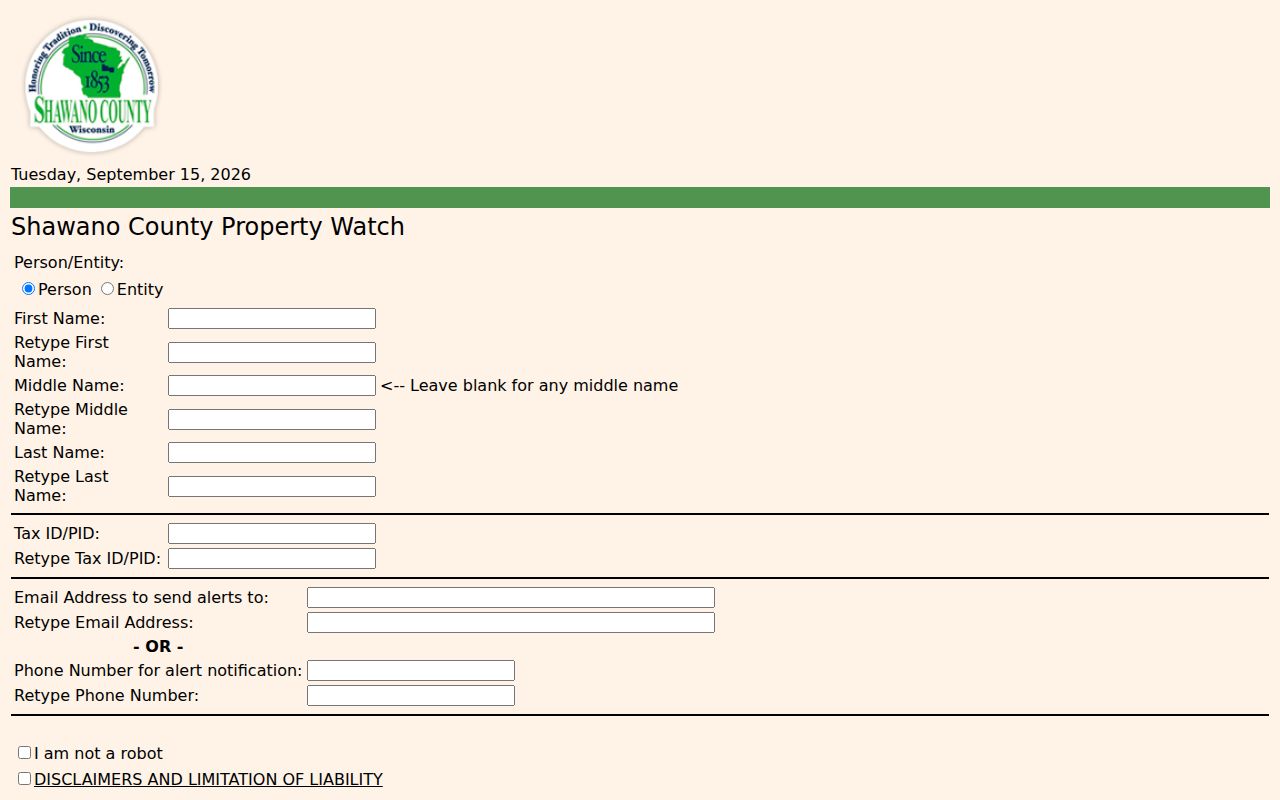
The registration screen lists the alert service's name or PID and contact fields. Those sit apart from the document search form.
Shawano Deeds and Court Records
Some recorded instruments tie back to a court case. WCCA opens the door to public Wisconsin circuit-court cases by party name and county. Shawano dockets cover foreclosure, construction liens, property disputes, judgments and tax warrants. A docket lists the case number, class, parties, filing date, activities, scheduled events and status. It is not a certified document file.
Search the index for the plaintiff, defendant or owner. Then request the complaint, judgment or exhibit from the Clerk of Circuit Court. A lis pendens can be recorded against a parcel. A final sheriff's deed may later appear in RecordEASE. Match the recorded document against the court's case status. A tax-deed land-for-sale notice is only an inventory signal, not proof that a transfer ever closed.
Use the WCCA case search for the docket route. The statewide interface includes a Shawano County selection, kept separate from the Register of Deeds instrument index.
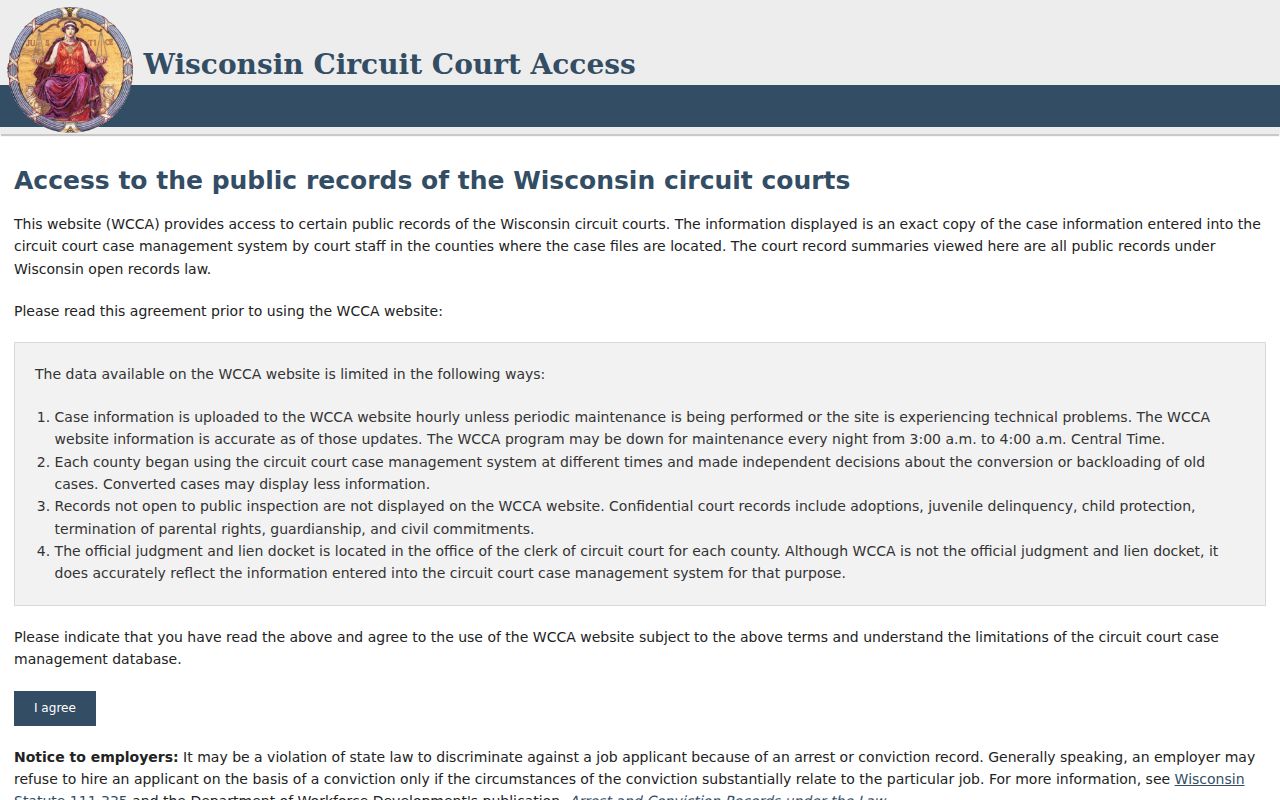
A court search can point to cases affecting a parcel. For the recorded instrument itself, RecordEASE remains the source.
Requesting a Shawano Deed Copy
A downloaded index image and a certified copy serve different needs. For a legal or ownership decision, ask the Register of Deeds for a certified copy and cite the recording reference. If the document falls outside the online date range, provide the parcel, party names, and the best date span you have. A clear request lets staff identify the instrument without drafting a title opinion.
Phone help is available at 715-524-2129 through the county office at 311 N Main Street in Shawano. Online downloads follow the posted $2 first-page and $1 additional-page schedule plus the stated $5 credit-card-session fee. Ask the office about any current copy or certification charge before sending a payment. The Register of Deeds publishes no complete pre-1986 deed-book inventory, so confirm older access directly with the office.
Earlier owner research follows the deed chain backward through grantee and grantor roles. That historical method, including how far the chain reaches and where older records live, is covered in former Shawano County property owners.